
IAINU Tuban Holds Social Survey and Mapping Training for PTKIS
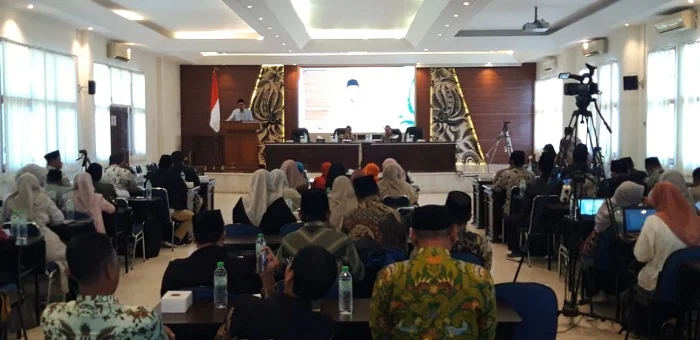
The Nahdlatul Ulama Islamic Institute (IAINU) Tuban continues its capacity building efforts for lecturers. In collaboration with the Forum of Leaders of Private Islamic Religious Higher Education Institutions (PTKIS) in the Pantura Zone, the university under the auspices of Nahdlatul Ulama (NU) held a social survey and mapping training. The training, which featured speakers Prof. Murtadlo from the National Research and Innovation Agency (BRIN) and Masduri Amrawi, a senior researcher at the Poltracking Survey Institute, was held in the RH. Ronggolawe meeting room on the third floor of the Tuban Regency Government (Pemkab) building. The training was opened by Dr. Moh. Masyhudi, Assistant for Governance and Public Welfare of the Tuban Regency Government, representing Tuban Regent Aditya Halindra Faridzky. The day-long training was attended by PTKIS leaders from the Pantura region, including Tuban, Lamongan, Bojonegoro, and Gresik. In his remarks, Rector Prof. Dr. M. Syamsul Huda, S.Fil.I., stated that surveys and social mapping are crucial because they are a necessity in many areas. For research universities, this survey-based approach needs to be developed because it has a direct impact on policies, changes, and evaluations of government policies and social change. "Therefore, this training is crucial," he said. Surveys, continued Prof. Syamsul, are a form of scientific and accurate data collection in various fields, such as politics, social sciences, economics, education, and others, precisely and quickly, not just analysis but reality. Universities can be an important part of governments, companies, businesses, and others. "Because before issuing a product, whether in the form of legislation or policies, regulations, or decisions, they can conduct surveys or research," he added. According to Prof. Syamsul, surveys are also an important part of the global world. There are survey institutions in the fields of economics, education, social sciences, and others. In Indonesia, there are also many credible survey institutions from universities that are used for academic or government purposes. "It even has the potential to help those aspiring to become council members. With an initial survey, we can map out the direction of change and predict future leadership," he explained. The Bojonegoro-born professor said that one of Masduri's sources was his philosophy student at UINSA, who then moved to Jakarta to become a researcher. Two years before the change in national leadership, he conducted a survey. Then, two to three months before the election, Prof. Syamsul received the results of the survey again. "So, two years before the leadership change, I was given the survey results. They were detailed, as the survey was conducted down to the neighborhood association (RT) level. Then, two months before the election, I received another report to show the percentages. It turned out to be accurate, not out of line. What does this mean? This is important: campuses are partners, and the government can receive accurate information, especially on policies and services, whether those services are truly needed, or what future services will be prioritized," he said. Meanwhile, Dr. Mujib Ridwan, MA, MSi, Head of the Pantura Zone PTKIS Leadership Forum (Forpim PTKIS), stated that he had recently met with the central PTKIS Leadership Forum. One of the key initiatives is to encourage PTKIS to produce professors as soon as possible. Several efforts have been made, including requesting the Ministry to open more frequent opportunities for internships. Second, expediting the issuance of decrees for those who have applied for Associate Lecturer positions. "Hopefully, this will be successful soon. Some have already issued their SK (Decree and LK) letters. If everything goes smoothly, PTKIS will have a bumper crop of professors. Some have already received their SK (Decree and LK) letters. In the Pantura PTKIS, he continued, many have already submitted their LK letters, but many have not yet been issued. "The Forpim Chairman hopes that it won't be long before professors emerge from PTKIS within the next 2-3 years." "This is part of an effort to avoid stagnation in academic research, let alone stagnation in lecturer positions, so that in the future, professors from PTKIS (Islamic Higher Education Institutions) in the north coast of Indonesia will emerge," he added. Furthermore, according to Mujib, other ideas related to journals are also being considered. International journals are still very limited. There are none in the north coast, and even Sinta 2 journals are very rare. He believes that the north coast needs serious attention because it is still lagging behind compared to the southern region. The average is still Sinta 4, although some have achieved Sinta 3. "This means we have to be truly serious. Mojokerto and Kediri already have international recognition, so let's push ourselves, let's improve our writing and journals," he urged. Meanwhile, Dr. H. Moh. Masyhudi, Assistant for Government and Public Welfare at the Tuban Regency Government, expressed his hope that the training would be beneficial. He also expressed his gratitude to IAINU for holding this strategic training, saying it could improve knowledge and skills, as well as enhance the competency and capacity of participants. The data-based survey training is conducted in accordance with government policy, which is also based on digital data. Therefore, the public must also be digitally literate and keep up with developments in information technology in this era. The development of the digital era demands faster and more accurate work, all based on data or evidence. "The Regency Government, universities, and community organizations need data to design programs and evaluate the impact of development. This training is very important," he concluded.